Contact Form

Name

Email *

Message *

Search This Blog

Tuesday, March 12, 2024

Ramanujan : a great mathematician

 read more about Ramanujan on;https://sushmajee.com/shishusansar/stories-great-indians/14-ramanujan.htm
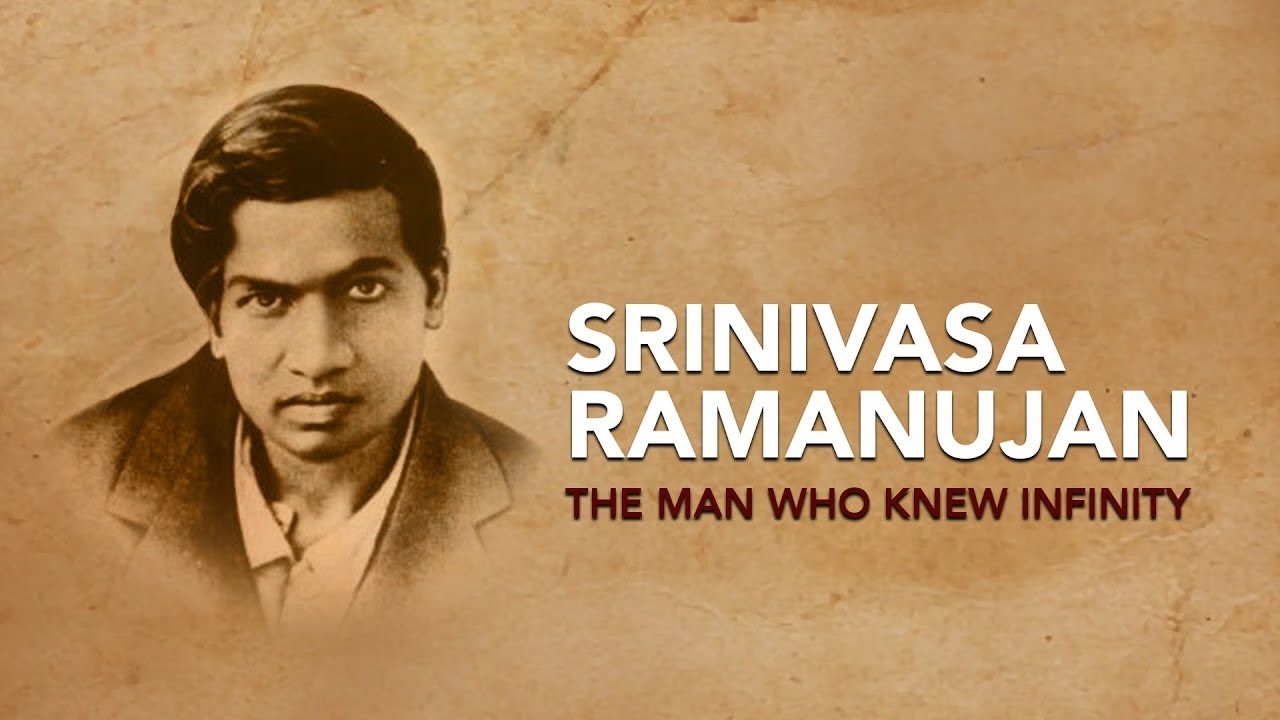


Ramanujan : a great mathematician

Dec 22, 1887 - Apr 26, 1920 (32 yrs)
See also his  Magic Square

Srinivasa Ramanujan, FRS, was an Indian mathematician and autodidact who, with almost no formal training in pure mathematics, made extraordinary contributions to mathematical analysis, number theory, infinite series, and continued fractions. As he had no access to large community of mathematicians, he developed his own mathematical research in isolation. As a result, he sometimes rediscovered known theorems in addition to producing new work. Ramanujan was said to be a natural genius by the English mathematician GH Hardy.

Ramanujan was born in a poor Braahman family. His father's name was K Srinivasa Iyengar and his mother's name was Kamalatammal. His father was a clerk at a Saree shop and his mother used to sing at a temple. They lived on Sarangpani Street in Kumbakonam, Tamil Naadu. He was divinely inspired. When his grand-mother Rangammal, an ardent devotee of Goddess Namagiri (the Goddess of their family deity Lord Narasinh Temple in Namakkal, Tamil Naadu) went to the Temple, she went into a trance and supposedly the Goddess spoke to her and said that - "The Goddess herself will speak to the world through her daughter's son".

He was formally introduced to Mathematics at the age of 10. He mastered the books on advanced trigonometry written by SL Loney by the age of 12. He even discovered theorems of his own, and re-discovered Euler's identity independently. He demonstrated unusual mathematical skills at school, winning accolades and awards. By 17, Ramanujan had conducted his own mathematical research on Bernoulli numbers and the Euler–Mascheroni constant.

Ramanujan received a scholarship to study at Government College in Kumbakonam, but lost it when he failed his non-mathematical coursework. He joined another college to pursue independent mathematical research, working as a clerk in the Accountant-General's office at the Madras Port Trust Office to support himself.  In 1909, he was married to a 9-year old girl - Janaki Ammal, at the age of 21 years.

Ramanujan in England
In 1912–1913, he sent samples of his theorems to three academics at the University of Cambridge. One mathematician MJM Hill told that he lacked educational background and foundation to be needed by mathematicians. Still he gave him professional advice on whose basis he wrote to three professors in the University of Cambridge. HF Baker and EW Hobson returned his work. Then he wrote to GH Hardy with his 9 pages of work which he thought he was a fraud. But some of his formulae got his attention and recognizing the brilliance of his work, invited him to visit and work with him at Cambridge. He worked with him for nearly 5 years.  Here it was a clash of different cultures, beliefs and working styles. Hardy was an atheist and an apostle of proof and mathematical rigor, whereas Ramanujan was a deeply religious man and relied very strongly on his intuition.

He got a BA degree, which was later converted in a PhD degree, in 1916. He became a FRS (Fellow of the Royal Society) in 1918 becoming the second and the youngest Indian, following Ardaseer Cursetjee in 1841. He became the first Indian to be elected as a Fellow of Trinity College, Cambridge in 1918. He could not tolerate the living conditions outside India being a vegetarian he fell ill and suffered with Tuberculosis and severe vitamin deficiency. He came back from there in 1919 and soon after he died of illness, malnutrition, and possibly liver infection in 1920 at the age of 32.

Ramanujan's Notebooks
Ramanujan had written his work in 4 notebooks on loose leaves before going to England. Most of them were without derivation. Since paper was very scare in those days and the slate was very popular for solving problems, he must have used slate. The 1st notebook had 351 pages, with 16 somewhat organized chapters and rest unorganized. The 2nd notebook was of 256 pages, under 21 chapters and 100 unorganized pages. His 3rd notebook contained 33 unorganized pages. And the 4th notebook contained 87 unorganized pages - it was rediscovered in 1976.

He credited all his knowledge to his family Goddess, Namagiri of Namakkal. There are two interesting incidents in Ramanujan's life that I wish to share here --

(1) Meeting with Mahalanobis
Once one Sunday morning PC Mahalanobis (who founded the Indian Statistical Institute in Calcutta and also become a Fellow of the Royal Society) went to meet Ramanuja in Whewell's Court. Mahalanobis said to him - "Now, here is a problem for you." He told he used to visit a Belgian friend whose house was on a long street. They were numbered on this side 1, 2, 3 and so on, and that all the numbers on one side of him added up exactly the same as all the numbers on the other side of him. He knew that there were more than fifty houses but not so many as five hundred. He wanted to know his friend's house number.

Through trial and error, Mahalanobis had figured out the answer. Ramanujan figured out too but he gave a general solution to the problem using continued fraction. A continued fraction whose denominator consists of a number plus a fraction, ad infinitum. As stated, the problem had one solution - house number 204 in a street of 288 houses - i.e., 1 + 2 + 3 ---- + 203 = 205 + 206 + ---- + 288. But without the 50 to 500 house constraint, there were other solutions - for example, house number 6 in a street containing 8 houses - i.e., 1 + 2 + 3 + 4 + 5 = 7 + 8. Ramanujan's continued fraction comprised within a single expression - all the correct answers. Mahalanobis was astounded. How interesting!

"The limitations of his knowledge were as startling as its profundity," Hardy would write. Mahalanobis was also a great Mathematician. In fact, Pandit Nehru liked him a lot. And when Nehru asked him - "How to solve India's poverty?", Mahalanobis immediately wrote a very long equation with Partial Differentials that filled the whole black board. Then he explained, each and every variable in the equation again completely zapping Nehru.

(2) Meeting with Hardy
Once GH Hardy came to meet Ramanujan in a taxi from London. Hardy noticed the number - it was 1729. He thought little about the number and said it was "rather a dull number". Ramanujan immediately retorted, "No, Hardy, it is a very interesting number. It is the SMALLEST NUMBER that can be expressed as the sum of TWO CUBES in TWO DIFFERENT WAYS". That is, it is the smallest number that can be expressed as 12 x 12 x 12 + 1 x 1 x 1 but also as 10 x 10 x 10 + 9 x 9 x 9. How interesting! Coincidentally, 1729 is also a Carmichael Number.

His Work
During his short lifetime, Ramanujan independently compiled nearly 3900 results (mostly identities and equations). Most of his claims have now been proven correct, although a small number of these results were actually false and some were already known.

He has produced a square with numbers - it is really superb. Would you like to see it - Click here to see that square. Ramanujam has given the method as how to draw a magic square involving any important date, not only birth day, except a few. In Kharuraho Paarashwanaath Jain temple (10th century ) one can find a magic square engraved.

712114
213811
163105
96154

This is referred to as the Chaunteesaa Yantra, since each row, each column, each diagonal, 2 x 2 sub-squares the corners of each 3 x 3 and 4 x 4 square, the two sets of four symmetrical numbers (1 + 11 + 16 + 6 and 2 + 12 + 15 + 5), and the sum of the middle two entries of the two outer columns and rows (12 + 1 + 6 + 15 and 2 + 16 + 11 + 5), sums to 34.

Honors
In recognition of his contributions, the Government of India has declared Ramanujan's birthday (22 December) should be celebrated every year as National Mathematics Day, and also declared 2012 as the National Mathematical Year.

[I ]

Monday, March 11, 2024

JADBHARAT,जडभरत


JADBHARAT,जडभरत

All about Jadbharat, you may find on this link;

https://www.google.com/search?q=sushmajee.com+jadbharat&rlz=1C1GCEA_enUS1032CA1047&oq=sushmajee.com+jadbharat&gs_lcrp=EgZjaHJvbWUyBggAEEUYOTIGCAEQRRg8MgYIAhBFGDzSAQkxNjU1NWowajSoAgCwAgA&sourceid=chrome&ie=UTF-8#ip=1


you may read some interesting stories about Raja Jadbharat on;https://www.sushmajee.com/bhagvatjee/kathaa/skandh5/2-jad-bharat-1.htm


Sushma,s favourite stories;

Jadbharat-1
6-Naarad Puraan, 1-Poorv Bhaag, p 175-179
See also 3-Vishnu, 2-Dwiteeya-7

This second part of Poorv Bhaag of Naarad Puraan is very big - p 153-400=250 pages. It contains a few chapters on grammar astrology, and Chhand. Most of this information is omitted here.


Story of Jadbharat-1

Naarad Jee said - "I have heard the way to remove all kinds of sorrows, still I am deluded. It is my mind is not getting settled. Tell me if evil people behave against the will of other people, then how the people can tolerate it?" Soot Jee said - "Sanandan Jee remembered the story of king Bharat and said to Naarad Jee - "I will tell you an old story about this. This story will give you a lot of consolation. There was a king named Rishabh Dev whose son was Bharat, on whose name this land is called Bhaarat Varsh. Bharat ruled the Prithvi with a great care. Later he handed over his kingdom to his sons and went to Pulah and Pulastya Rishi's Aashram in Shaal Graam Kshetra. He lived there and worshipped Prabhu.

One day he went to take bath in Shaalgraamee River in the morning and worshipped there standing in the waters for three Muhoort (two and half hours). At the same time a pregnant she-deer came there to drink water in that river, as she had drunk water that she heard the terrible sound of a lion roar, she got frightened and jumped over the bank of the river. The bank was a bit high, so while jumping on the bank, her fetus came out of the womb, fell in the river and started flowing in the river. Bharat kindly picked the fetus. The she-deer also fell on the bank and died with grief. Bharat brought the deer cub to his Aashram and started taking care of him. He also started growing under his loving care. He loved him very much, more than his sons, kingdom and relatives. His worship got disturbed by caring him.

After some time Bharat died. At the time of death that deer cub was looking at him and he was looking at the deer only. Because of his feelings in deer, he was born as a deer in his next life, but he remembered everything of his previous life. He got Vairaagya, left his mother and lived in Shaalgraam Kshetra. He ate dry leaves and grass there. Thus he did Praayashchit of the Karm for which he got this deer's body. Then he was born as a Jaatismar Braahman. He knew Shaastra already. He knew Aatmaa beyond Prakriti and Devtaa etc like himself. He did not study Ved etc. If somebody asked him something, he replied like fools. That is why all people used to insult him. Appreciation harms a Yogee and insult takes him towards Bhagavaan, so he used to behave like a Jad (foolish) person. He ate whatever he got. When his father died, his brothers started taking work from him on the farms. He lived on their remaining food, but he was very stout. He worked very hard, that is why all people took work from him.

One day Sauveer king was going to Kapil Muni's Aashram on the banks of Ikshumatee River riding in his palanquin. He wanted to know from him that what was the best thing for people to do in this sorrowful world? So on that day some extra people were taken in the service of the king. He was also taken and he carried king's palanquin along with others. He was walking seeing two yard land ahead lest any small living beings are dead so he was moving slow, but his coworkers were walking fast. The king noticed that his palanquin was shaking because of the uneven speed of the carriers, so he said to the carriers - "What are you doing? Walk with the uniform speed." But the speed still remained the same. This time the king scolded them, then the other carriers told him that the new man was walking slowly.

The King-Braahman Dialog

Then the king asked him - "Are you tired? You have carried the palanquin only for a short distance, are you not able to do hard labor? You seem to be quite stout." Braahman said - "Raajan, neither I am stout, nor I have carried your palanquin. Neither I am tired, nor I am doing any labor. The carrier of this palanquin is somebody else." The king said - "I can see that you are stout and palanquin is still upon you, and people do labor while carrying any load."

The Braahman said - "Listen to me O king, At the bottom is Prithvi, on Prithvi there are two feet, on two feet there are two thighs, and on them is stomach. On stomach is chest, on chest are shoulders and arms, and on shoulders is kept this palanquin. In such situation, there is no weight on me. In palanquin also, your "so called" body is kept. You, all other beings and I - all are carried by Panch Bhoot. All three Gun (Sat, Raj and Tam) are under control of Karm, and this Karm is collected by all beings because of A-Vidyaa. Because the soul is pure, A-Kshar (conscious), peaceful, Nir-Gun and beyond Prakriti. It never grows or deteriorates. When it never grows or deteriorates, then how did you say that "You are fat". And if this palanquin (kept on Prithvi, feet, thighs, and shoulders respectively) can be a weight for me; then it can be a weight for you also. And with this analogy, all others also have lifted not only this palanquin, but also all mountains, trees, planets and Prithvi etc. With whatever material this palanquin is made of; yours, others and my bodies are also made of the same material."

After saying this the Braahman got quiet still carrying the palanquin on his shoulders. The king immediately got down from the palanquin and held his feet, he said - "Please leave this palanquin, and be kind to me. Tell me who are you in this disguise? Whose son are you? And why have you come here?" Braahman said - "Hey Raajan, You have asked, "Who am I", I cannot tell you; and you have asked me the reason to come here, its reply is that everybody goes here and there just to bear the fruits of his Karm. This Jeev takes up the body only to bear the fruits of whatever Karm, Punya or Paap, a Jeev has done; and all these conditions of the Jeev are because of its Punya and Paap (Dharm and A-Dharm actions)."

The king said - "There is no doubt, that the causes of all Karm are Dharm and A-Dharm and the soul has to go from one body to another to bear the fruits of its Karm, but as you said, "Who am I" this cannot be told", I could not understand this. I wish to know this." Braahman said - "The "I" word is pronounced by tongue, lips, and teeth etc, but they are not "I"; they are only the means to pronounce it. Then does this speech call "I" to only itself through tongue? No, because in this situation it cannot say "you are fat". This body is separate from Aatmaa, then where should I use this "I" and for whom?

If there is any other Aatmaa, like my own Aatmaa, then saying "This is I" and "This is other" could be meaningful; but when there is only one Aatmaa present in all beings, then asking "Who am I" or "Who are you" etc is useless. Saying "You are king", "this is palanquin", and "these people are carriers of palanquin" is also not true. From tree came the wood and from wood was made this palanquin on which you are sitting. If it is called palanquin, then where its tree and wood names have gone? Your servants do not say "See, the king is riding on tree", everybody says that "You are riding in a palanquin". But then what is palanquin? - a few wooden pieces collected together (assembled in a certain fashion); and the same is known as palanquin. Separate the wood from palanquin, and then search for your palanquin, where is that palanquin? In the same way, separate umbrella's all parts and then search for umbrella, where it has gone?

The same analogy applies to you and me also, (our bodies are nothing more than Panch Bhoot). Man, woman, elephant, cow, goat, bird, tree etc names are given only to these bodies which are taken to do various Karm - one should know thus. This souls is neither Devtaa, nor human being, nor an animal nor a tree - these are only the various forms of bodies which are born according to their Karm, soul is same in everything. Everything in this world is imaginary, they are not true. Which does not change into a new thing after some time, that is only Paramaarth thing. Think about that thing, what is that?

For your people you are a king, for your father you are a son, for your wife you are a husband, for your son you are a father, then what are you for me? What should I call you? In fact what are you? Are you your head? or neck? or feet? You just think what are you after separating yourself from them. Aatm Tattwa exists separated from all things, and when it can be known only by separating like this, then how can I tell you by the name of "I"?"


Home | Puraan | 6-Naarad Puraan

 read this tory over here;https://www.sushmajee.com/hindupuraan/8agni/32-jadbharat.htm
Jadbharat

8-Agni Puraan, Ch 377-380, p 828-837

Gyaan; Dialog between Keshidhwaj and Khaandikya; Jadbharat and Sauveer King's dialog;


Raja Bhartrihari, राजा भार्तिहारी

 Raja Bhartrihari, राजा भार्तिहारी

read in detail; https://www.sushmajee.com/reldictionary/literature/authors/bhartrihari.htm


Raajaa Bhartrihari
See also    Introduction to Vaitaal Stories 2-2;     Bhartrihari's Teachings
A similar story appears in Tripur Rahasya also - Story of a Handsome Prince

(660-740 AD) A philosopher, law-giver, poet and grammarian. His most famous works are "Neeti Shatak", "Shringaar Shatak", and "Vairaagya Shatak" - each consisting of 100 verses on the topics of moral conduct, pleasures of the senses, and renunciation. "Shringaar Shatak" has been written from the point of view of males where the woman is at once the joy of life and the source of sorrow. She can be the best guide in virtue and can take a man to worst evils. Still he says that life of a man without a woman is empty. "Neeti Shatak" is a marvel of great aphorisms on righteous conduct and many of the aphorisms are, even today, the best statements ever made to guide human beings into right conduct. "Vairaagya Shatak" is a complete turn-about from his "Shringaar Shatak" where he says that the pleasure of flesh is meaningless.
[Aangiras, p 260-261]

ASHTAVAKARA; अष्टावक्र

 ASHTAVAKARA; अष्टावक्र

one can read more on;https://www.sushmajee.com/biographies/bio-A/ashtaavakra.htm

Ashtaavakra
For stories about  Ashtaavakra and King Janak read  Janak-2

The story of Ashtaavakra is taken from the great ancient Indian epic, the Mahaabhaarat - MBH, G-4-Van/23, although he is mentioned in Vaalmeeki Raamaayan also, in Yuddh Kaand. When Dasharath Jee comes to Raam (V-Raamaayan, 6/119/17) to tell that He spread his fame like Ashtaavakra spread Kaahod's fame. His story takes three chapters in Mahaabhaarat. It is the story of a deformed young boy whose intelligence surpassed many old sages of his time. He was the Guru of King Janak and sage Yaagyavalkya. He was one of the 9 great Rishi, Yaagyavalkya and Gaargee were others, in King Janak's court.

Sage Uddaalak ran a school (Aashram) teaching Vaidik knowledge. Kaahod (or Kahol) was one of his best disciples. Uddaalak was so pleased with him that he got his daughter Sujaataa married to him. Sujaataa, eventually got pregnant and wanted her child to surpass all the sages of his time. So, she began to sit in the classes taught by Uddaalak and Kaahod, listening to their chanting with the unborn baby. It was one day, in a class taught by Kaahod, that the unborn baby spoke up from inside the womb, "This is not the way to chant the verse, Father." This happened at eight times. Kaahod felt insulted in front of the class and cursed, "You will be born deformed from eight places of your body." So when the child was born he was slanted from eight places of his body - two feet, two knees, two hands and chest and head. That is how he was named as Ashtaavakra.

Kaahod and Raajaa Janak
Sujaataa did not take the instance too seriously and was ambitious to have a son. She wanted more money to raise her child in the best way she could, so she asked her husband to go to King Janak who was then preparing for a fire worship ceremony (Yagya) at that time, hoping that the ceremony will bring money to the family.

When Kaahod approached the King Janak, the King received him respectfully but said with regret - "Kaahod, I am sorry, I am unable to perform the Yagya which I decided to perform several years back. A Sage Bandhi arrived here from nowhere and asked me to start the Yagya only after he is defeated in an academic discussion with the sages participating in the Yagya. His condition further included that the sages who come forth for the debate, if defeated, will be drowned in the river. So far he has killed many learned sages. Now it is up to you to take the challenge." Kaahod agreed to debate with Bandhi. Unfortunately Kaahod was also defeated by Bandhi and so he was drowned in the nearby river. Kaahod reached Varun's region. The widowed Sujaataa heard the news and repented for her actions.

A few months later she gave birth to a boy who was deformed at eight joints as cursed by his father, so he was named as Ashtaavakra. He got his education from his grandfather (Naanaa) Uddaalak Muni. Ashtaavakra was extremely intelligent and his grandfather loved him very dearly and was very proud of him. When Ashtaavakra was only twelve, he finished all that he needed to know from his grandfather. He also heard about the fate of his father and the Yagya of the King Janak which still remained unfinished as no one could defeat Bandhi.

Ashtaavakra Brings His Father Back
One night Ashtaavakra ran away from his hermitage and came to King Janak. Looking to his deformed body, the guards were amused. Ashtaavakra retorted - "Do not judge a person by his appearance and age, judge him by what he knows. Inform your King that there is a person ready to challenge Bandhi." The King came and was surprised to see a small deformed boy. He asked him a few questions and was greatly impressed by his knowledge. King Janak soon arranged the debate for him with Bandhi. When the spectators laughed on seeing the deformed Ashtaavakra, Ashtaavakra said with anger - "I did not know that the so called learned gathering in your court is no better than a bunch of cobblers who judge a person by the skin and not by the knowledge he has."

To everyone's surprise Ashtaavakra defeated Bandhi in no time. With vengeance he then requested the King to drown his father's killer. Bandhi then disclosed his identity. He said - "I am the son of Varun, the god of water. I came to Earth on the request of my father to get the best sages from here to perform his 12-year Yagya. The only way I could get them to my father was to challenge them in a debate and throw them into water. Now that my father has completed the Yagya, let us go to the river bank and watch the sages walk out of the river."

People rushed to the river bank and watched the sages returning from the river. Kaahod also came out of the river and embraced his learned son Ashtaavakra. He then openly admitted that his son Ashtaavakra was a lot more intelligent than he himself. Bandhi then asked Ashtaavakra to take a dip in the river, with the blessings of his father Varun, he made him normal. Ashtaavakra did so as he was told and as he came out of the river after taking the dip he came out as a handsome young man. Janak was very impressed with Ashtaavakra and rewarded both Ashtaavakra and his father Kaahod. They went back to their hermitage to be united with their family. Uddaalak Muni, was so happy to see his worthy grandson surpassing in knowledge to all the great sages of his time. Sujaataa also rejoiced at seeing her handsome son and the husband.

This story comes in Tripur Rahasya also with an additional subject matter, read it in Tripur Rahaya, Chapter 15.

---------------------------------------------------------------------------------------

This is the last and only last story told by Sushma to her daughter-in-law, RITU GUPTA from her hospital bed , just a few days before her leaving us for ever.

Sunday, March 10, 2024

Biographies Ashtaavakra

 you may read the biography of Ashtavakra here;https://www.sushmajee.com/biographies/bio-A/ashtaavakra.htm

also interesting stories of Ashtavakra 

Ashtaavakra Geetaa can be read at these sites --
(1) Original in Sanskrit
(2) Ashtaavakra Geetaa - in Sanskrit with English translation side by side
(3) Ashtaavakra Geetaa - English translation

Read Other Stories About Ashtaavakra
Story of the King Chitrabhaanu Related to Shiv Raatri
Stories About Ashtaavakra and Janak

Biographies-Rishi


Ashtaavakra

Biography of Ashtavakra


BIOGRAPHIES of Rishi, Rakashash and mythological personalities and figures

 BIOGRAPHIES of Rishi, Rakashash and mythological personalities and figures

https://www.sushmajee.com/biographies/index-bio.htm


  Biographies of thousands of Rishi, Rakshash and other mythological figures are given on the above link; a single and great source of information. Personalities from Ramayan, Mahabharat and other Vedic scriptures like Puranas etc.are chosen and biographies are arranged alphabetically.

Monday, November 6, 2023

BARBARIK; Khatu Shyam

 BARBARIK; Khatu Shyam;बर्बरीक, खाटू श्याम, घटोत्कच, भीम, हिडिम्बा, मुरा, मारवी, स्कंद पुराण,

Barbarik, now known as Khatu Shyam was the son of Ghatotkach and Maurvi and grandson of Bhim ( Pandav) and Hidimba ( Rakashashni); Maurvi ( Ahilawati) was daughter of Mura (Daitya) , the General of Narakasur ; Mura was killed by Krishna and after he was known as MURARI. In his previous life , he was a Yaksha.